

Chromatography
Everything Your LC Lab Needs, All From One Source
Jul
Everything Your LC Lab Needs, All From One Source
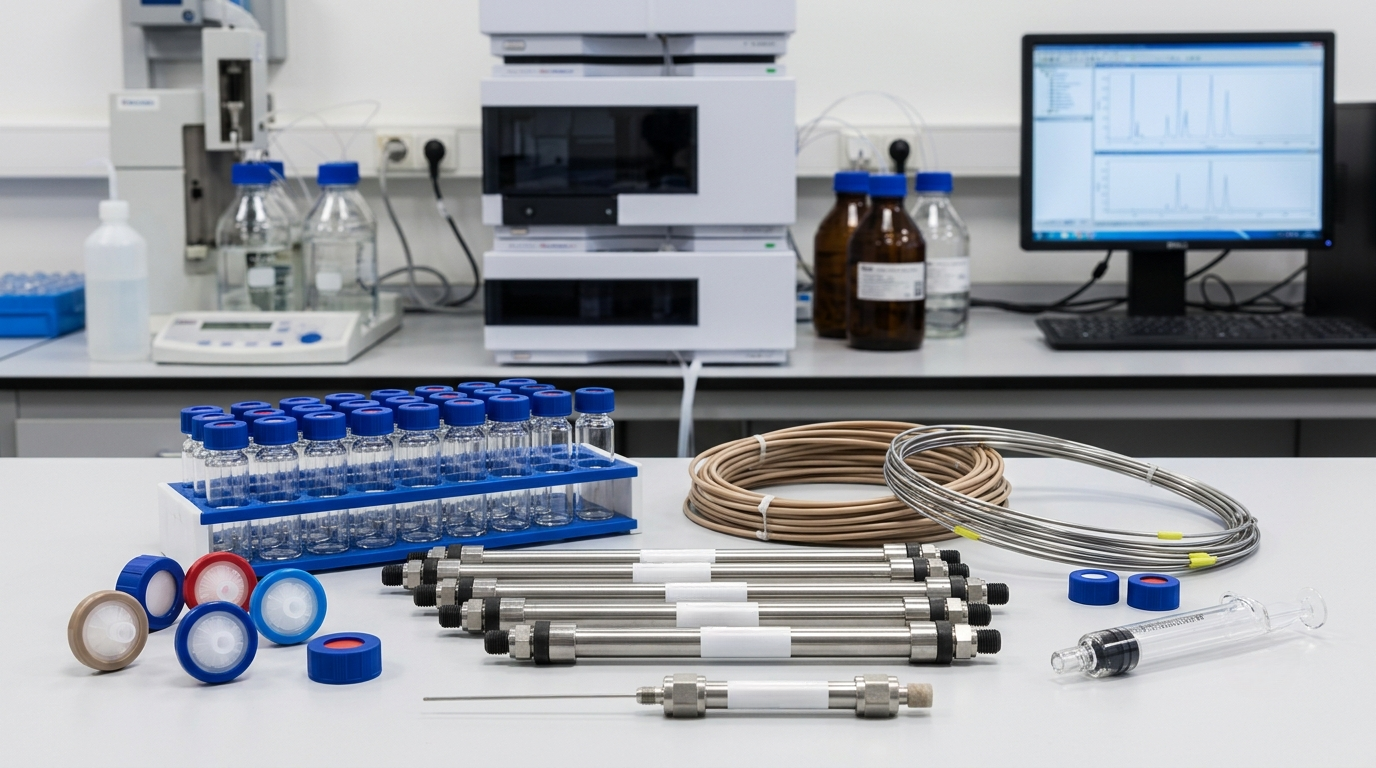
Columns, autosampler parts, pump supplies, mobile phase management, tubing, and more — a walkthrough of GMICore’s full liquid chromatography lineup.
A single LC system depends on dozens of small, easy-to-overlook parts — a worn pump seal, a degrading frit, or the wrong ferrule can throw off a method just as easily as the wrong column. Sourcing all of it piecemeal from multiple vendors slows labs down and creates gaps right when a system is down. GMICore’s liquid chromatography lineup covers the full system, end to end, so restocking and troubleshooting both run through one source.
LC Columns: From Analytical to Prep Scale
The LC columns lineup spans analytical columns for routine separations, guard columns to protect analytical columns from matrix contamination, prep-scale columns for purification and isolation work, and bulk packing materials for labs that pack their own hardware. Whether you’re running C18 reversed-phase methods or need a specialty phase, this is the starting point for matching the right chemistry to your separation.
LC Autosampler Supplies: Keeping Injections Precise
Injection precision depends on autosampler components that stay in spec run after run. LC autosampler supplies cover the parts that wear fastest — needle assemblies, rotor seals, metering device seals, sample loops, and seal pack kits — so a worn seal or a leaking loop doesn’t quietly skew your injection volumes.
LC Pump Supplies: Keeping Flow Consistent
Pump performance is what keeps retention times reproducible from injection to injection. LC pump supplies include the pistons, plunger assemblies, diaphragms, filters, and frits that make up a pump’s wear kit, along with cartridges for check valve maintenance — the parts you replace on a schedule rather than wait to fail mid-run.
Mobile Phase Management: Cleaner Solvent, Fewer Baseline Issues
A surprising number of baseline and pressure problems trace back to mobile phase handling. Mobile phase management supplies — solvent bottles, caps and tops, inline filters, degassers, column heaters, flow splitters, and mixers — keep dissolved gas, particulates, and temperature swings from showing up as noise in your data.
LC Tubing & Fittings: Getting the Plumbing Right
Dead volume and leaks are usually a plumbing problem, not a column problem. LC tubing and fittings cover the full connection path — tubing, fittings, connectors, couplers, crosses, and elbows — so you can rebuild a flow path correctly instead of forcing an ill-fitting part into place.
LC Detector & LC-MS Supplies: Supporting Downstream Detection
LC detector supplies, including deuterium lamps, keep UV/DAD detectors performing to spec as source intensity naturally degrades over time. For labs running mass spec detection, LC-MS supplies cover source electrodes and nitrogen generation components that support consistent ionization and desolvation.
Tools & Organization: Making Maintenance Easier
Good maintenance starts with having the right tool on hand instead of hunting for it. Tools and organization supplies include maintenance kits, hand tools sized for LC fittings, and organizers that keep small parts sorted and ready for the next service call.
Frequently Asked Questions
What’s the difference between a guard column and an analytical column?
A guard column sits upstream of the analytical column and is designed to trap particulates and strongly retained matrix components before they reach — and degrade — the analytical column. It’s a sacrificial, lower-cost line of defense that extends the life of the more expensive analytical column behind it.
How often should LC pump seals and pistons be replaced?
Replacement intervals depend on solvent chemistry, run volume, and pump design, but pistons, seals, and check valve cartridges are wear parts that should be replaced on a preventive schedule rather than only after a pressure or leak failure shows up mid-sequence.
Why does mobile phase degassing matter for LC results?
Dissolved gas in the mobile phase can form bubbles in the pump or detector flow cell, causing pressure fluctuations, noisy baselines, and irreproducible retention times. Proper degassing keeps the mobile phase delivery consistent, which is foundational to reproducible chromatography.
Explore the full liquid chromatography collection to find the columns, parts, and consumables your LC system runs on.